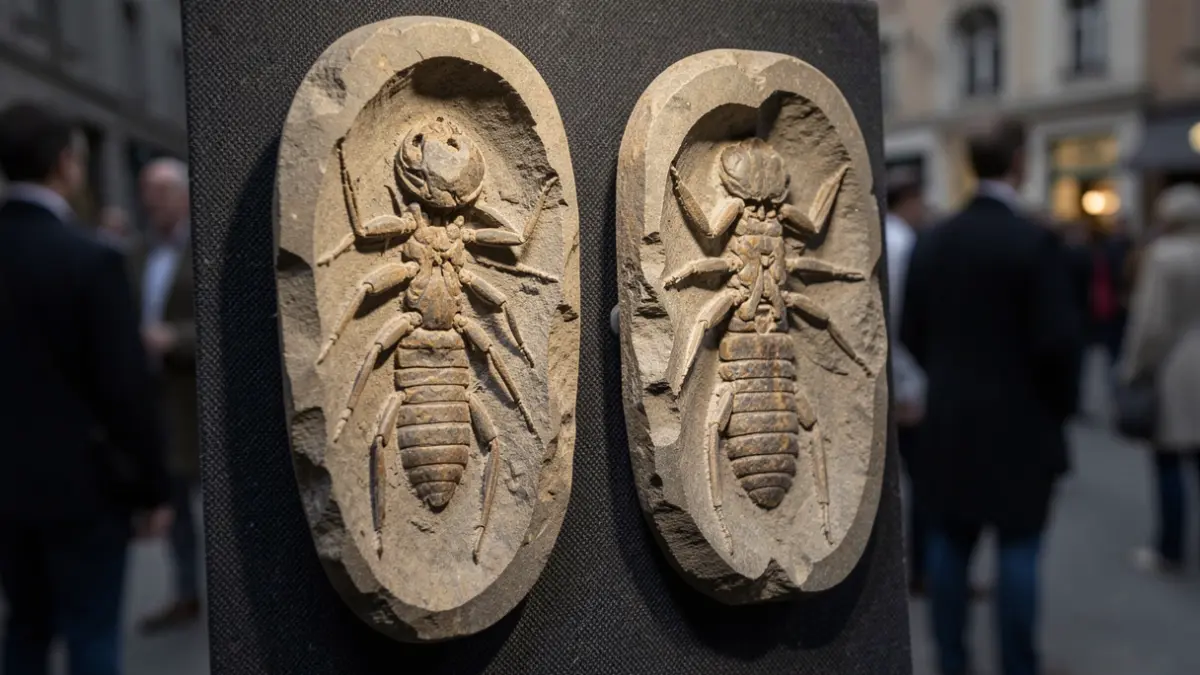
The fossil, discovered by Sara Silva, a PhD in Geosciences from FCUP, was found during an open-cast coal exploration. The young researcher collaborated with Helena Couto, a retired professor from FCUP and a fossil specialist, to identify the species.
“Carboniferous insect nymphs are quite rare,” explained Helena Couto. “They are difficult to attribute to specific groups of organisms with a common ancestor, which are generally defined based on adult insect fossils,” she added.
The specimen, preserved in two external molds and measuring about 10 mm in length, shows morphological similarities to modern dragonfly nymphs, featuring a bulky abdomen and large, anteriorly oriented hind legs, suggesting a possible aquatic lifestyle. The absence of wings indicates it is a young nymph.
The discovery, published in the scientific journal Neues Jahrbuch für Geologie und Paläontologie, does not correspond to any known Paleozoic nymph. The morphological characteristics have led researchers to two hypotheses: a greater affinity with nymphs of the extinct order Paoliida, due to short cerci, elongated and robust femora, and an elongated abdomen; or similarities with the order Plecoptera, known since the Pennsylvanian, based on the relative position of the hind legs.
The work also includes contributions from Torsten Wappler, a paleontologist and entomologist from the University of Bonn, and André Nel, an entomologist from the National Museum of Natural History, CNRS, Sorbonne University, Paris.
The researchers now hope to find a better-preserved specimen that will allow for a more precise identification by observing the head structures and wing buds.