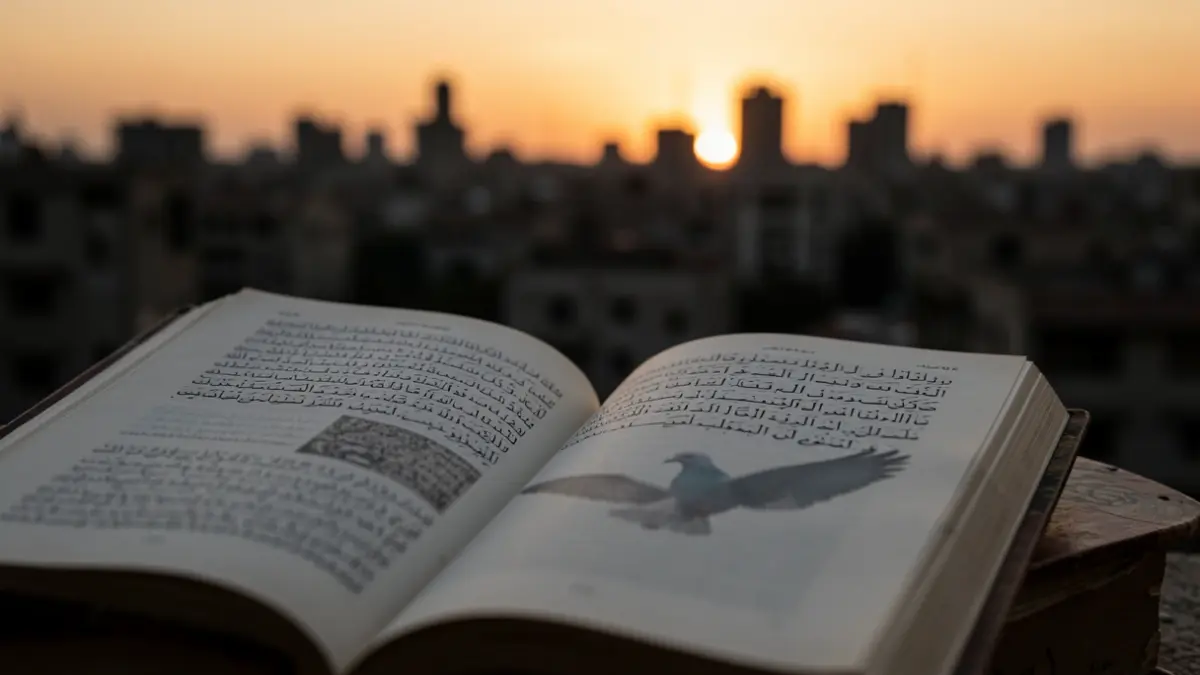
Moroccan writer Rachid Benzine, 55, stated that "books can be an act of resistance when everything is falling apart," particularly in contexts of war or dictatorship, where literature becomes a refuge and a means to preserve inner freedom. In an interview with FÓLIO 2026, Benzine addressed the importance of the Palestinian narrative and criticized how the conflict is portrayed by Western media.
Benzine explained that while books cannot stop bombs, they allow us to "preserve an inner freedom that no power can take away." He cited testimonies of people in prisons who resisted through reading poetry. In his book "The Man Who Read Books," the character Nabil Al Jaber finds refuge in literature, receiving works like "The Human Condition" by André Malraux and poems by Mahmoud Darwish from the bookseller, representing life's harshness and the need for a harmonious perspective.
The author criticized journalistic coverage that, in his view, excessively focuses on violence and spectacle, appealing to emotion and fear, leading to a distorted perception of reality. "News has become a field where emotion and fear are increasingly appealed to," he lamented, adding that the normalization and amplification of violence on social media contribute to this negative worldview.
Benzine emphasized the importance of giving voice to invisible narratives, such as the Palestinian one, which has become "inaudible" in France since October 7, 2023. "Talking about Gaza in France means social death," he confessed, recounting experiencing "annulment" and "inequality in terms of access and plurality of narratives." For the writer, writing about Palestine is a literary and political act that affirms the right of that history to exist, recalling that the conflict dates back to 1948, not just October 2023.
Addressing the political issue, Benzine mentioned that Benjamin Netanyahu had information about an imminent Hamas attack, and that Israeli policy has never seriously considered the idea of a Palestinian state. He described the war as "political" and "colonial," where international impunity allows "the strong to tend to become barbaric." He lamented the collapse of international law in Gaza, where, despite UN and ICC conclusions, the law was not applied.
The writer argues that ending the cycle of revenge requires forgiveness, citing examples like Mandela and Gandhi, but stressed that forgiveness is only possible after justice. Regarding the coexistence of different interpretations of Islam, Benzine called for respect for plurality and acceptance of differences between progressives and conservatives. The responsibility of leaders in conflict is "enormous," especially for the most powerful, who have the capacity to "do much more" and choose "not to retaliate."
Finally, Benzine reflected on the inequality at borders and freedom of movement, contrasting Portugal's experience after joining the European Union with that of African migrants. "We have to realize that this freedom is not equal for us and for them," he concluded, warning about the "tense forehead" that characterizes the current relationship with others, despite seeking their resources.