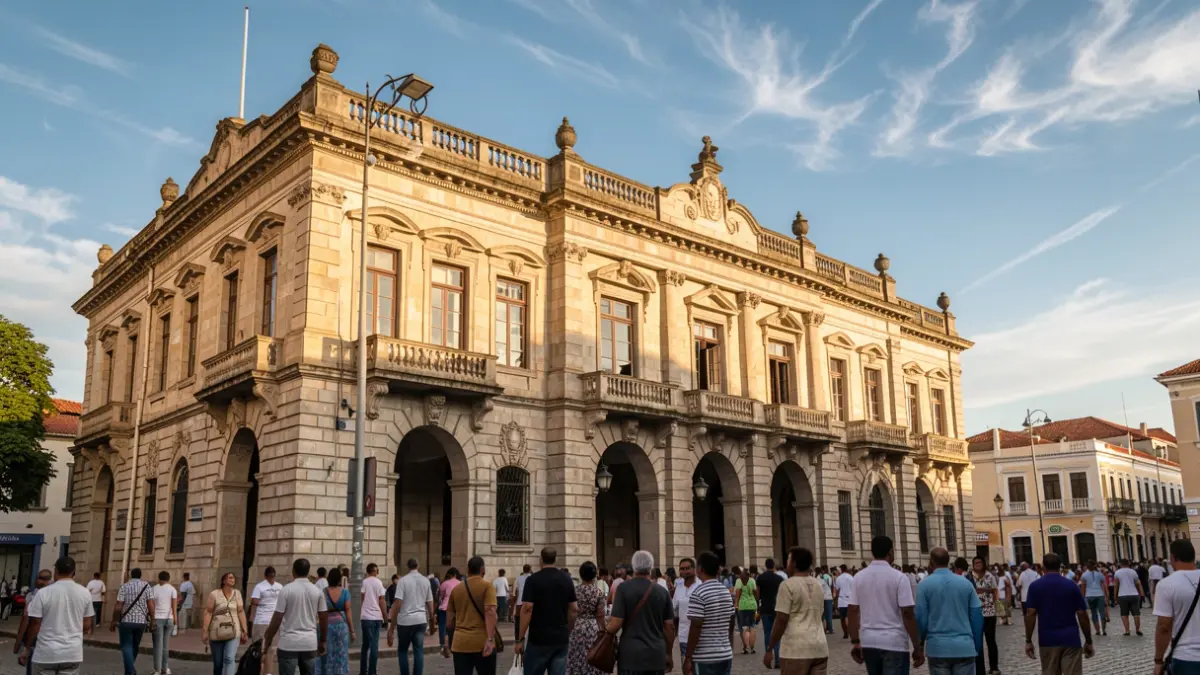
The event, supported by the municipalities of Aljezur, Lagos, and Vila do Bispo, was attended by policymakers, technicians, professionals, and investors. The opening session was chaired by the President of the Municipal Chamber of Lagos, Hugo Pereira, who highlighted the initiative's objectives: to promote reflection on the fragilities of the planning system and the disarticulation of sectoral strategies, and to identify solutions for effectively reconciling environmental, socioeconomic, and cultural dimensions within a vision of balanced and sustainable development.
Geographer Margarida Pereira addressed the administrative and procedural constraints in implementing the Territorial Management System (SGT), pointing out fragilities and dysfunctions arising from bureaucracy, dispersion of competencies in Central Administration, scarcity of municipal technical resources, and an excess of laws. She advocated for reforms in governance, simplification of the SGT, and changes in the planning approach.
Law Professor João Miranda analyzed the concepts of collaboration, cooperation, and coordination in institutional relations. He criticized the 'top-down' planning perspective, the lack of inter-administrative commitment culture, and the fiction of an inter-municipal level. He argued that the Municipal Master Plan (PDM) should be an instrument of territorial public policy, beyond being merely legal.
Fernanda Paula Oliveira, a university lecturer, discussed the housing crisis in the Algarve, arguing that the solution is not solely through increasing buildability. She emphasized the need to define where, for whom, at what price, and with what capacity housing is needed, identifying the execution crisis as a central problem. She advocated for a supramunicipal approach and inter-municipal cooperation for housing, territorial, and mobility policies.
Urbanist and landscape architect Sidónio Pardal criticized the current planning model as a 'straitjacket' that hinders rational land use distribution and blocks development. He called for the recovery of the concept of 'Planning' through creativity, scenario exploration, and support for political decision-making, warning against blind bureaucracy replacing conceptual planning.
The president of CCDR Algarve, José Apolinário, closed the proceedings, discussing the agency's role in Territorial Planning and Management and advocating for the creation of an intermediate level within the Territorial Management System. He mentioned the REOT (Report on the State of Territorial Planning of the Algarve) and the subsequent revision of the PROT (Regional Territorial Planning Program).