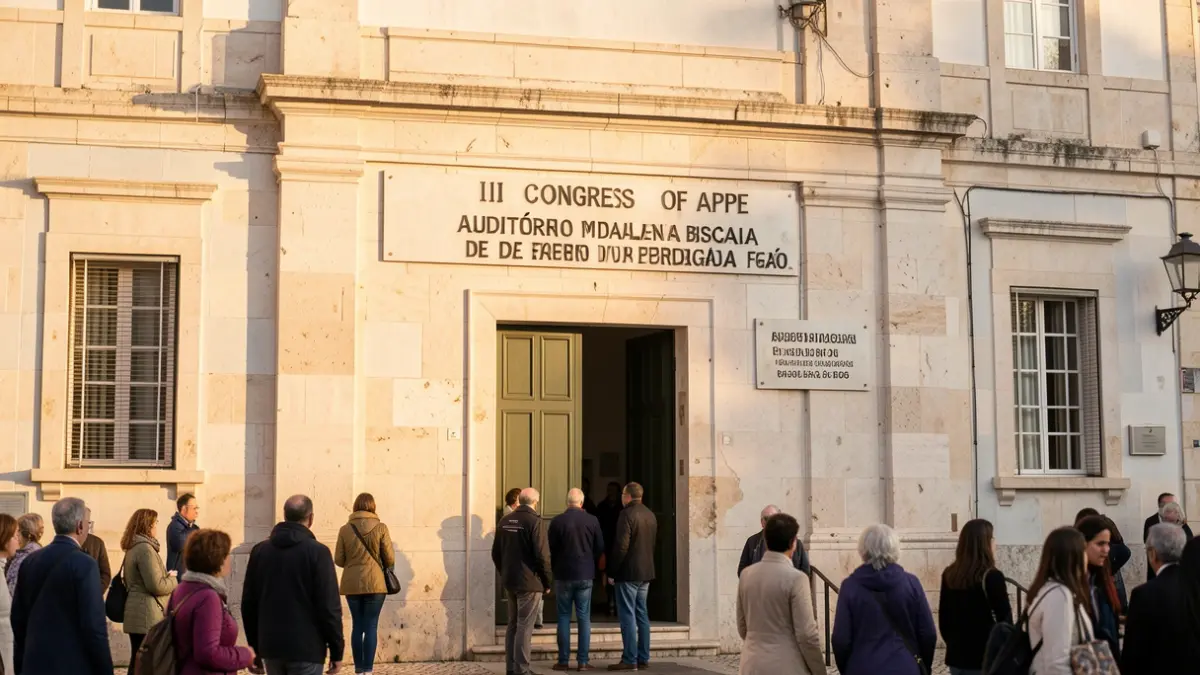
The XV Congress of UGT kicked off this Saturday in Figueira da Foz, with a strong call for the valorization of work, the defense of labor rights, and the reinforcement of social concertation. Artificial Intelligence (AI) and its challenges for the job market were central themes in the speeches of the Minister of Labor and union leaders present.
The event, which runs until Sunday, October 11, under the slogan «Together for a Fairer Future», brings together union leaders and institutional representatives in the city. The objective is to debate the current challenges of the world of work and outline the main guidelines and the UGT's union strategy for the 2026-2030 mandate.
At the opening session, UGT president Lucinda Dâmaso thanked the Figueira da Foz municipality for its support and highlighted the union's role as a «strong pillar of democracy», based on pluralism and freedom. She also evoked historical figures like Mário Soares and Francisco Sá Carneiro, emphasizing the principles that UGT seeks to preserve.
Pedro Santana Lopes, president of the Figueira da Foz Municipal Chamber, expressed the honor of hosting the congress at the Center for Arts and Spectacles (CAE), an cultural facility he deemed vital for the city's affirmation. He highlighted the careers of union leaders and praised the UGT's independence and freedom of thought, recognizing its ability to support positive government measures while also firmly defending workers' rights.
Santana Lopes also advocated for a development strategy for Figueira da Foz that goes beyond tourism, pointing to scientific research, marine sciences, the environment, and the study of ocean currents as crucial areas for the municipality's competitiveness. He specifically mentioned the research center dedicated to ocean currents and climate change, as well as the academic activity of the University of Coimbra campus.
The Minister of Labor, Solidarity, and Social Security, Maria do Rosário Palma Ramalho, emphasized the importance of dialogue and commitment in democratic construction, through negotiation between diverse interests for the collective good. She acknowledged UGT's historical role in social concertation, even during crisis periods like the Troika intervention.
The minister warned about the transformative impact of Artificial Intelligence on the labor market and labor relations. While recognizing AI's productive potential, she cautioned against the risk of human function replacement and the need to prepare workers and companies for this transition. It is estimated that six out of ten workers may need retraining, making training a priority. The minister assured the government's availability to negotiate with social partners and prevent Portugal from being unprepared for the digital transformation.
At the closing session, UGT Secretary-General Mário Mourão called for the government and business organizations to be seen as partners, not adversaries, in improving living and working conditions. He stressed the union's unity and reaffirmed the priorities: valorizing work, strengthening rights, and building the future.
Mourão argued that economic growth should translate into better wages, quality employment, and reduced inequalities. He made a direct appeal to the prime minister to review the agreement on wages and incomes, and argued that social concertation should be a space for decision-making and negotiation, not just consultation. "Social concertation cannot be silence," he stated, demanding a strong and determined UGT.
The opening session included a cultural moment with Joana Vilarinho and a tribute to deceased leaders and unionists. Messages from international union organizations were also conveyed, with the Spanish representative expressing admiration for UGT's work.