Póvoa de Lanhoso PDM Review Boosts Housing and Economic Areas
The new municipal master plan increases construction capacity and the Ecological Structure, with public consultation until November 9.
By Rui Tavares Fonseca
••3 min read
AI
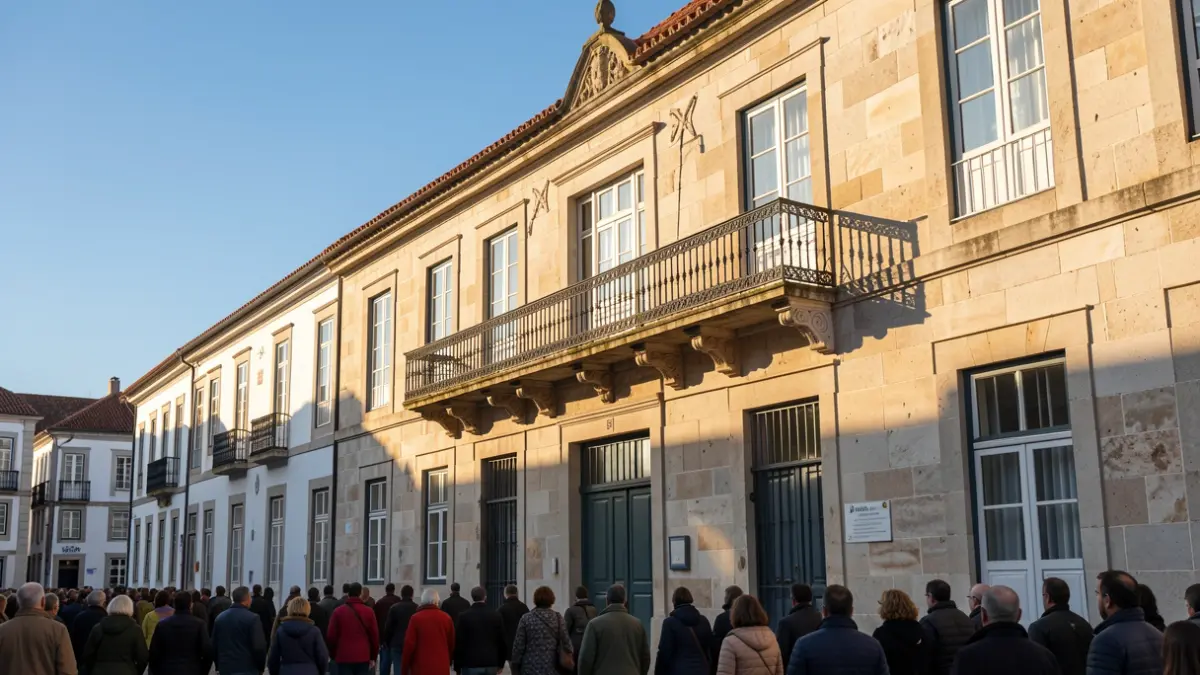
Facade of a municipal building in Póvoa de Lanhoso at dusk.
The 2nd Revision of the Municipal Master Plan (PDM) for Póvoa de Lanhoso, under public consultation until November 9, increases construction capacity for housing and economic activity, and expands the Municipal Ecological Structure.
The proposal for the 2nd Revision of the Municipal Master Plan (PDM) of Póvoa de Lanhoso aims for a profound update of the territory's planning, seeking to create conditions to meet the needs of the coming decades. The plan reinforces territorial capacity for housing, economic activity, investment, facilities, and infrastructure, while also expanding the area integrated into the Municipal Ecological Structure and maintaining a strong presence of areas subject to environmental and agricultural protection.
The President of the Municipal Chamber of Póvoa de Lanhoso, Frederico Castro, presented the 2nd PDM Revision on Monday morning, September 28, at the Interpretation Center of Carvalho de Calvos.
One of the central dimensions of the revision is the creation of better conditions to meet housing needs. Spaces for Housing, Commerce, and Services increase by 67.16 hectares, rising from 2,025.36 to 2,092.52 hectares. The objective is to create greater capacity to respond to the evolving needs of families and population retention, framing growth within a logic of planning, infrastructure, and quality.
“
"We want a Póvoa de Lanhoso where people can choose to live, start a family, and build their future. Reinforcing territorial capacity for housing means creating conditions to meet the needs of future generations, but doing so in a planned, responsible, and quality manner."
The revision also introduces a significant change in the municipality's capacity to host economic activity. Economic Activity spaces increase by 77.97 hectares (82.4%), rising from 94.58 to 172.55 hectares. This strategic change aims to accommodate companies, new activities, and investment projects, increasing predictability for investors and reducing land-use conflicts.
Areas designated for Facilities and Infrastructure also show significant growth, with an increase of 36.82 hectares (79.5%), rising from 46.34 to 83.16 hectares. Overall, areas with construction capacity increase by 189.42 hectares (8.9%), from 2,131.09 to 2,320.51 hectares.
“
"We want Póvoa de Lanhoso to be a territory where it is worthwhile to invest. The 82.4% increase in areas designated for economic activities reflects a clear choice: to create space and predictability for companies, attract investment, and generate employment opportunities."
The reinforcement of construction and economic capacity is accompanied by a clear option for environmental enhancement. The Municipal Ecological Structure increases by 1,296.47 hectares (16.9%), rising from 7,664.23 to 8,960.70 hectares. This measure strengthens the identification and protection of areas with environmental, landscape, and ecological importance, integrating the environmental dimension into the territorial development strategy.
“
"Developing and protecting are not incompatible objectives. We want a Póvoa de Lanhoso with greater capacity to welcome families, companies, and investment, but we also want a more protected and valued territory. The increase of over 1,296 hectares in the Municipal Ecological Structure demonstrates that this revision precisely seeks that balance."
Areas integrated into the National Ecological Reserve (REN) and the National Agricultural Reserve (RAN) also undergo slight changes within the framework of the new territorial organization. The PDM revision aims to establish a long-term territorial vision, articulating objectives for population retention, economic strengthening, improved facilities and infrastructure, and protection of natural and landscape values.
The 2nd PDM Revision is under public consultation between September 28 and November 9, allowing citizens, companies, and institutions to consult the proposal and submit observations. After this period, contributions will be analyzed to consolidate the final proposal.