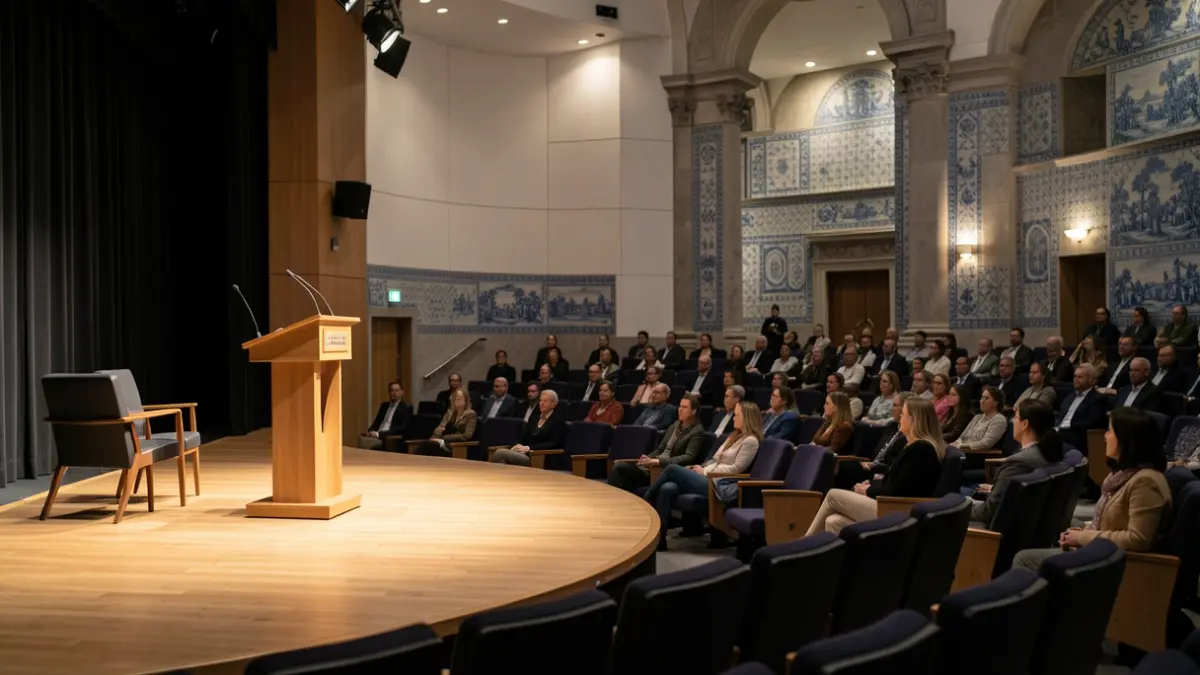
The town of Grândola hosted, on September 22, the inaugural meeting of the Municipal Commission for the Commemorations of the Centenary of the Birth of José Afonso. The gathering marks the start of preparations for a program that aims to celebrate, in a plural and comprehensive manner, the 100 years since the birth of a prominent figure in 20th-century Portuguese culture.
The commemorations are scheduled to take place between May 17, 2028, and August 2, 2029. These dates establish a symbolic link with two fundamental moments: May 17, the day José Afonso first visited Grândola in 1964; and August 2, the birth date of the author of the iconic poem «Grândola, Vila Morena».
José Afonso's first visit to Grândola on May 17, 1964, was a particularly significant moment. It was following this first encounter with the town and the relationship established with its inhabitants and the Sociedade Musical Fraternidade Operária Grandolense — Música Velha that José Afonso drafted the initial version of the poem «Grândola, Vila Morena». The song, recorded years later, became a major symbol of resistance to the dictatorship, and was broadcast by Rádio Renascença in the early hours of April 25, 1974, signaling the advance of the Armed Forces Movement that led to the establishment of democracy in Portugal.
The Commission brings together personalities with different backgrounds and connections to José Afonso, aiming to ensure a diverse approach to his work, artistic dimension, thought, and his relationship with Grândola and other territories.
The Commission includes Alcides Bizarro (Head of the Culture Division of the Municipality of Grândola), Hélder Costa (playwright, actor, and director), Arturo Reguera (closely linked to José Afonso in Galicia), Dulce Manuel (niece of José da Conceição), Guilherme Lourenço (young artist from Grândola), Irene Flunser Pimentel (historian), João Afonso (musician and nephew of José Afonso), José Fortes (sound technician and music producer), Luís Freitas Branco (author of «A Revolução Antes da Revolução»), Rui Pato (musician), Rui Vieira Nery (musicologist and historian), Viriato Teles (journalist), João Madeira (historian, representing the Associação José Afonso), and Adélia Botelho (President of the Sociedade Musical Fraternidade Operária Grandolense).
The presidency of the Commission is assumed by Francisco Fanhais, a singer and composer, a companion, and friend of José Afonso, a leading figure in Portuguese music and resistance to the dictatorship. His participation brings direct memory of a fundamental period in Portuguese cultural and political history to the Commission.
In the first meeting, the thematic bases of the program were laid, deadlines and work goals were established, and the conceptualization of a program began, intended to be representative and plural, worthy of José Afonso's stature and the importance of his work in the History of Portuguese Culture against the dictatorship and for the benefit of democracy.
Various ideas and proposals for the program were also put forward, covering different areas and languages – from music to historical research, from memory and heritage to artistic creation, including publishing, dissemination, and initiatives aimed at different generations.
The intention is for the program to involve the community of Grândola, cultural and educational institutions, researchers, artists, associations, and other entities, creating different moments of participation and reflection throughout the commemorative period.
The Commission will continue to meet in the coming months to consolidate a program that transcends the strictly commemorative dimension, allowing for a revisit of José Afonso's work, a deeper understanding of the man and his time, and a discussion of the cultural, artistic, civic, and democratic legacy of one of the greatest figures of contemporary Portuguese culture.
In Grândola, the land of fraternity where the story of a song became indelibly intertwined with the history of a country, the centenary of José Afonso will thus be marked based on a relationship that began in 1964 and continues to make the town an unmissable site in the country's collective memory.