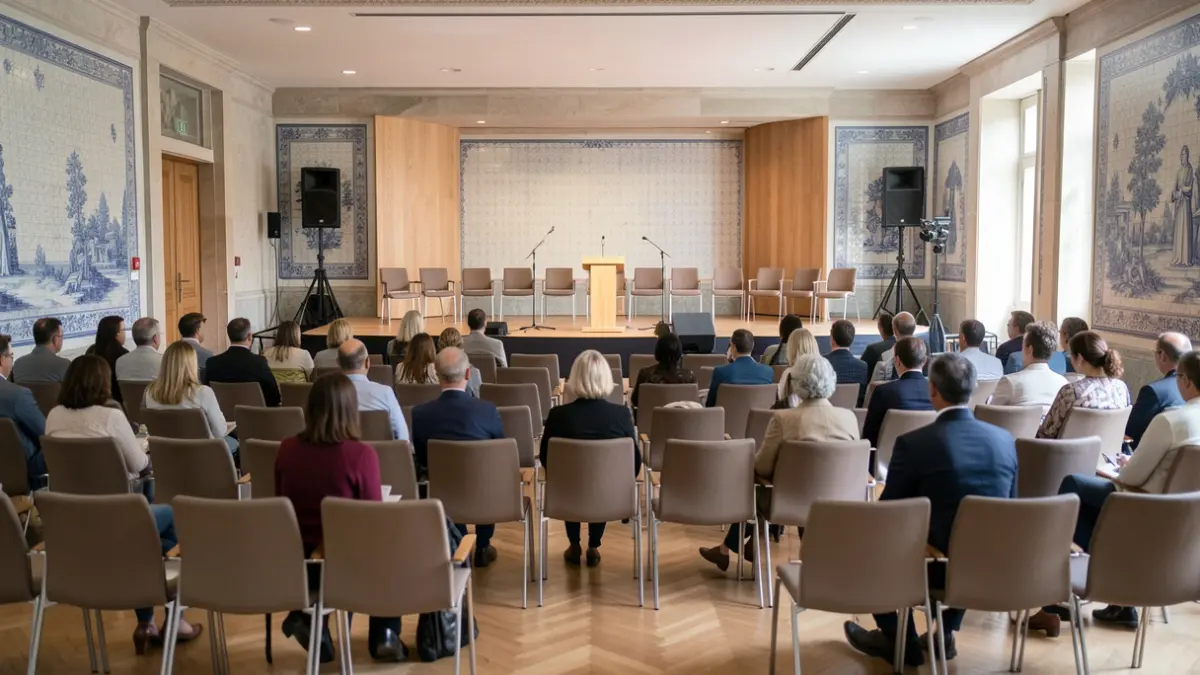
The postgraduate seminar “Future for Teachers: What Profession? What Knowledge? What Training?”, organized by IE-ULisboa within the framework of the UNESCO Chair «Futures of Education», was attended by approximately 200 participants. These included teachers, researchers, doctoral students, master's students, and initial teacher training students from ULisboa.
António Nóvoa, holder of the Chair, Professor Emeritus at IE-ULisboa, and former Rector of the University of Lisbon, argued that the current crisis in the teaching profession stems from the erosion of auctoritas – the authority derived from being the author of one's own work. Nóvoa emphasized the importance of regaining teachers' autonomy and strengthening their capacity for creation and intervention, beyond material demands.
Drawing from his recent book “Viagem pelas Escolas de Portugal” (2025), Nóvoa identified four threats to the teaching profession: futuristic visions that advocate for a future without schools and teachers; external interference in pedagogical autonomy; technical approaches that reduce teachers to mere implementers of prescriptive manuals; and administrative overload that detracts from time and space for creation and pedagogical work.
The response, he argued, lies in affirming teachers as authors of their work, knowledge, training, and educational policies. This involves reconfiguring school times and spaces for shared pedagogy, valuing the “clinical knowledge” emerging from practice, assuming a central role in initial and continuous training in partnership with universities and scientific research, and making their voices heard in the public debate on the humanistic and democratic mission of the School.
At the opening, Estela Costa, Director of IE-ULisboa, highlighted the need for a new social contract for Education, proposed by UNESCO, emphasizing the role of the UNESCO Chair “Futures of Education” in deepening North-South cooperation and reinforcing the partnership between the University and schools in teacher training.