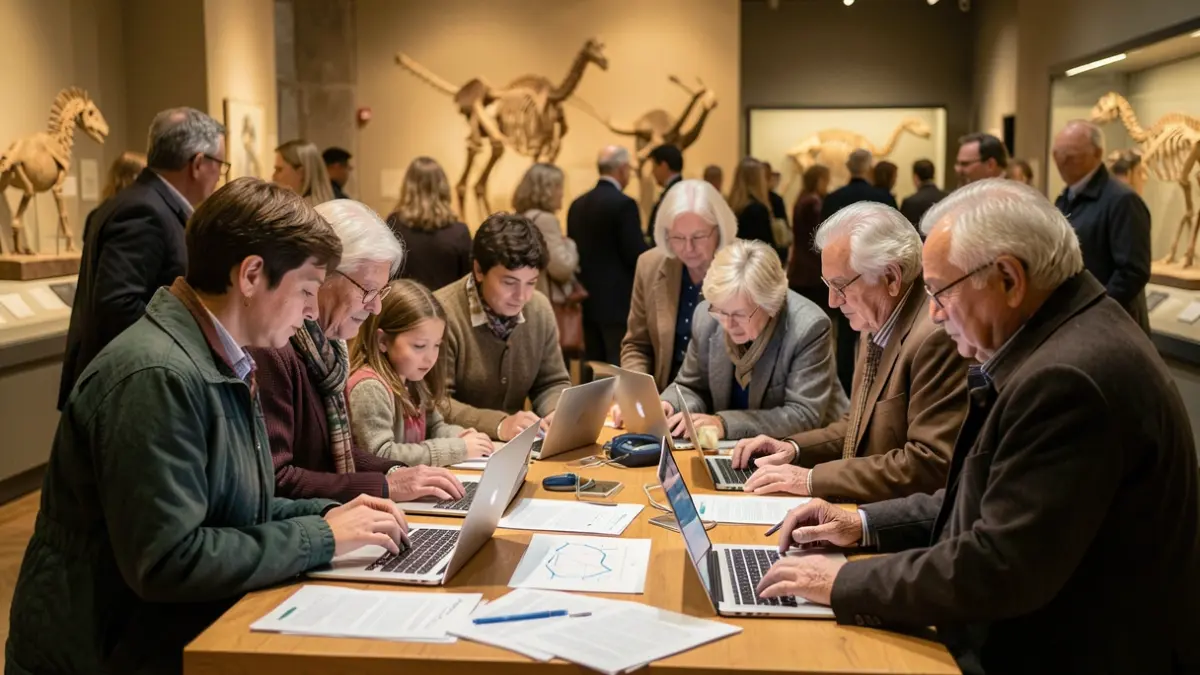
On September 25th, at the National Museum of Natural History and Science in Lisbon, the UNESCO Chair in Communication, Media Literacy and Citizenship (ESCS-UPL/LIACOM) launched the challenge: “What if you were a climate journalist for a night?”. The initiative, part of the European Researchers' Night, brought together nearly fifty participants of all ages to explore how news can address the diverse dimensions of climate change impacts.
The activity aimed to show that climate change transcends scientific and environmental spheres, serving as a lens to analyze areas such as health, politics, economy, and sports. It also sought to equip journalists with the skills to "translate" scientific data into accessible news, connecting the climate crisis to people's daily lives.
Based on data provided by the team, participants were invited to conceive ideas for reports, interviews, articles, videos, or podcasts, focusing on angles close to their reality. Constructing these pieces involved identifying sources, locations to visit, suitable images, and the final title.
The diversity of suggested topics reflected the audience's variety. A 13-year-old proposed a video on the effects of heat on children and school solutions to mitigate it. An older participant investigated the inclusion of heatwave protection measures in the Government's labor reform, especially for exposed workers, and the impact of climate change on art conservation.
Recalling the "storm train" of January and February, Sara and Maria Inês questioned the need for changes in urban planning, proposing the title: “Should we better plan cities for more frequent floods?”. Conversations extended to other topics like the impact of artificial intelligence in newsrooms, reinforcing journalism's role in understanding complex issues.
The initiative, led by researchers Vera Moutinho, Fernanda Bonacho, and Fátima Lopes Cardoso, along with Margarida Alpuim, aimed to promote debate, climate and media literacy, and critical thinking.
The research project “Climate Journalism at University: a cross-border project” was also presented, a collaboration between ESCS/LIACOM and Oslo Metropolitan University (OsloMet), funded by the EEA Grants program. This project led to the creation of the country's only Climate Journalism course, within ESCS's Master's program, surprising participants with its importance in preparing future journalists.
LIACOM's participation also included an activity on inclusive advertising, linked to the +LONGE – Consumption and Ageism project. The European Researchers' Night is an annual European initiative aiming to bring the public closer to scientific research.