Born in Salto, Montalegre, but with strong artistic ties to Porto, Fátima Carvalho dedicates her photographic work to exploring the temporal duration in natural elements like old trees, flowers, and fruits. Her camera focuses on what lives and transforms, seeking to capture the temporal tension inherent in each subject.
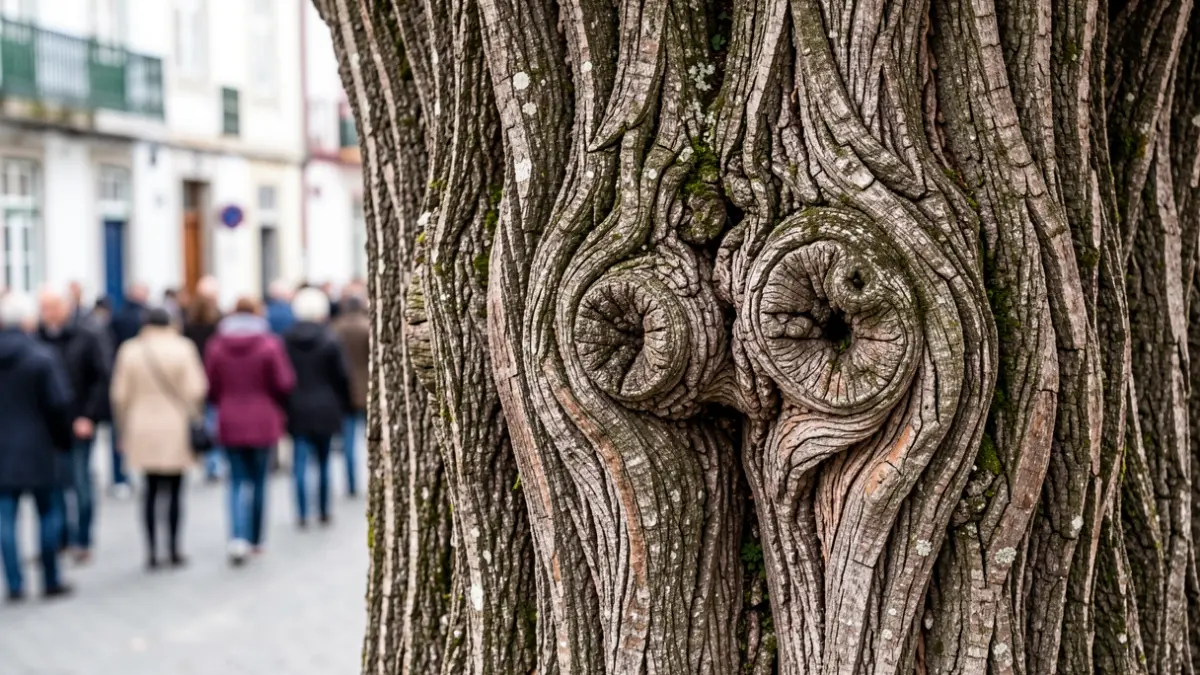
The series Árvores Vigilantes do Tempo (Trees Watching Over Time), part of Árvores & Flores (Trees & Flowers), features centuries-old trees photographed in black and white on artisanal paper and linen. These images, accompanied by texts from Rosa Alice Branco, Maria do Carmo Serén, and José Manuel Mendes, highlight the uniqueness and temporal traces of these botanical presences.
In Flores e Frutos (Flowers and Fruits), the second subtitle of the exhibition, the artist focuses on beauty linked to maturation and change of form. José Tolentino de Mendonça observes that Carvalho returns to the same subjects in different states and lights, capturing each photograph as an instant of waiting and new approach.
The poetic dimension, already present in the book Manhã Total (Total Morning) in homage to Eugénio de Andrade, is a key to appreciating Fátima Carvalho's work. Just as in poetry, looking at her images requires time, allowing one to discover unique qualities that a hurried observation would miss.
José Tolentino de Mendonça, in his text, highlights that Fátima Carvalho intercepts forms in their unfolding, probing their incomplete, pained, and ecstatic flow. The artist does not aim to immobilize what resists fixation, but rather to listen to the complex and the open, the mysterious flow of nature. Each image is a starting point for a vaster journey, where a flower or fruit condenses the memory of the earth.
Carvalho's work reveals a sapiential dimension, a knowledge produced in the creative process through empathy and silence. Each series is a research journey, a discipline that refines the gaze to reveal what haste conceals. The repetition of motifs, such as photographing the same flower or fruit in different states, is a method that allows for sharp discernment, where each return to the motif is a subtle departure, as nothing truly repeats identically.
The exhibition echoes the thought of Saint Augustine on the inner time of the soul, and of Donna Haraway on "Becoming-with". Carvalho explores psychic time, the lived wait, while Haraway proposes thinking with life forms, integrating the observer into the network being observed, in a knowledge born from contact rather than distance.
The idea of "life in relation" is central to Fátima Carvalho's work. Her flowers and fruits are not isolated but exist in relation to the air, light, and humidity. The artist captures the transition from one form to another, where decline is a necessary modality of life. Survival is collaboration, a pact with other bodies and cycles, as suggested by the phrase from Eugénio de Andrade: "we are all mouths waiting for the wind's ardor to become birds".