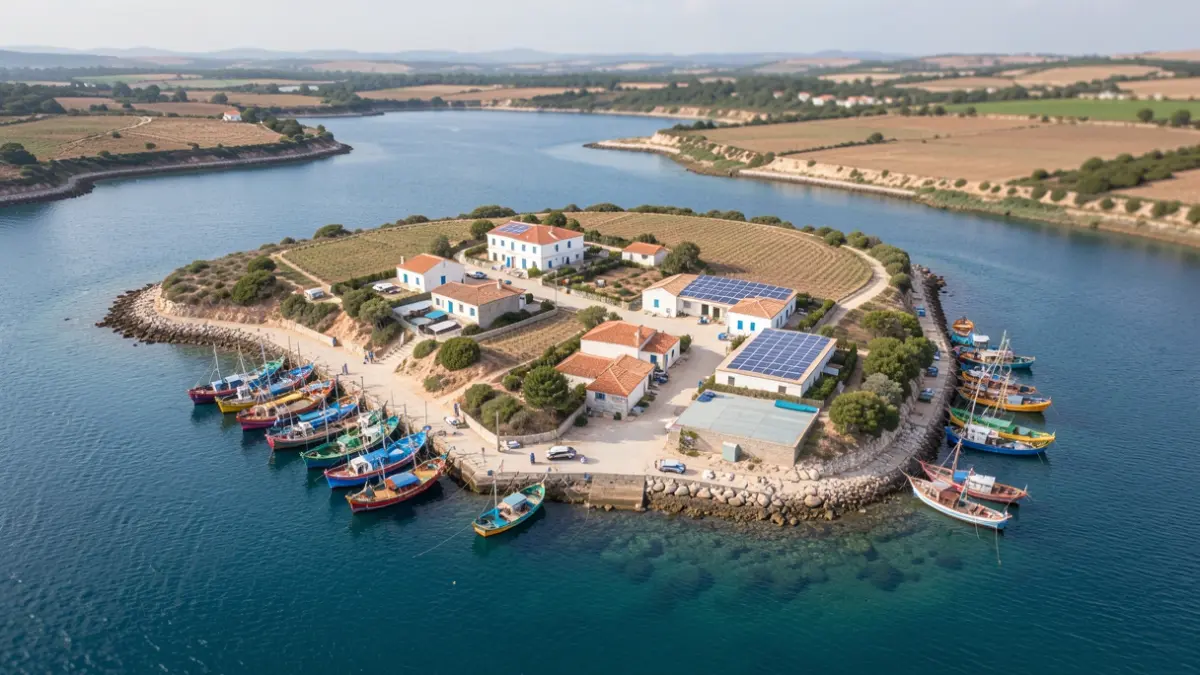
The island of Culatra, located in the heart of the Ria Formosa, has once again been the center of national television attention. In an episode of the program Hora de Agir, broadcast by RTP on October 3rd, the project Culatra2030 - Sustainable Energy Community was presented, illustrating how this fishing community has become a true laboratory for innovation and sustainability.
This transformation originates from the island itself, driven by its inhabitants and their daily experiences. The core objective is to find local solutions for challenges related to energy, water, waste management, and fishing, promoting a circular economy.
The Culatra2030 project, coordinated by the Marine and Environmental Research Centre (CIMA) of the University of the Algarve, integrates renewable energies, electric mobility, decarbonization of fishing activities, self-consumption water production, and waste valorization.
The initiative involves researchers from CIMA and the Higher Institute of Engineering of the University of the Algarve, the association Make it Better, and representatives from the associations of the Culatra Fishing Hub (Associação de Moradores da Ilha da Culatra, Associação Nossa Senhora dos Navegantes, and Clube União Culatrense). Young entrepreneurs involved in fishing, oyster farming, and fish farming also actively participate.
Jóni dos Santos, a Culatra resident, researcher at CIMA, and president of the Cooperative for the Sustainable Development of Culatra Island (C-Coop), is one of the most active voices. He emphasizes that the energy transition is only effective if it addresses the real needs of the community. The C-Coop is the promoting entity for the pilot project of a Renewable Energy Community, approved by ERSE in January 2023.
Within the scope of the SMART and DTCoastGRID projects, funded by FCT and developed at CIMA under the coordination of André Pacheco, Jóni dos Santos and Felor Abbasi are developing tools to monitor energy production and consumption, aiming for more efficient electricity management by the community.