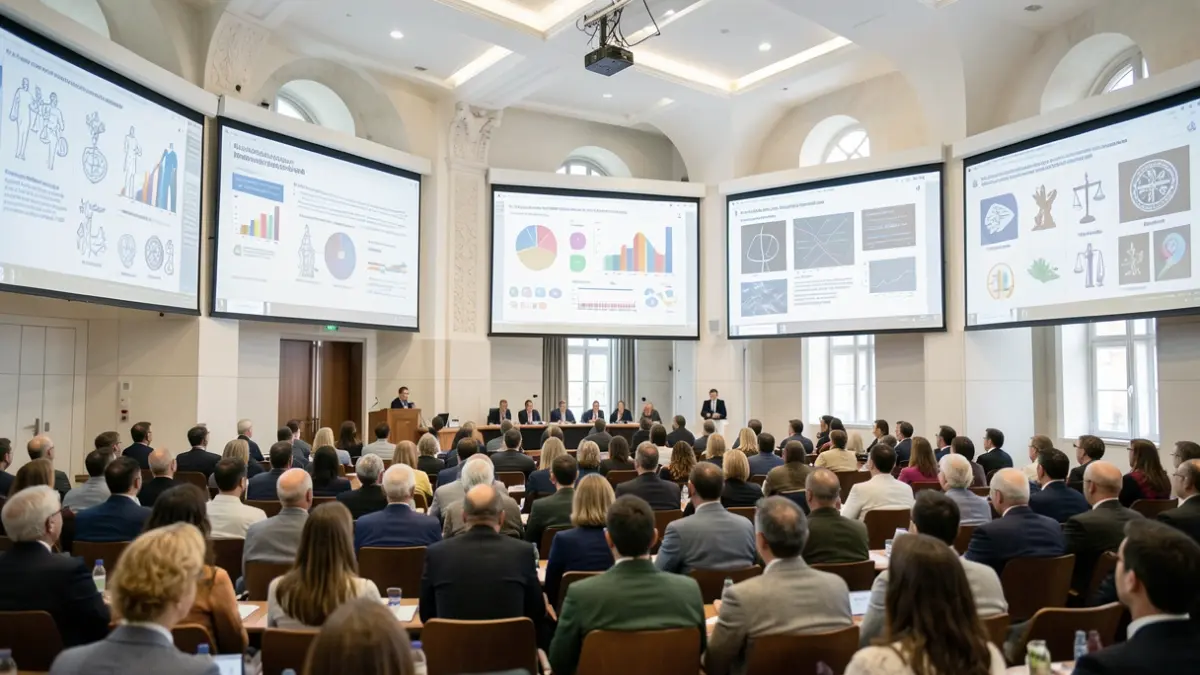
The event featured panels dedicated to experiences from Portugal, Brazil, China, the Council of Europe, and the European Union. The panel on Portugal included Manuel Dias, CTO of the State and member of the Agency for the Technological Reform of the State (ARTE), and Fabiana Clemente from KPMG US.
The panel on Brazil was moderated by João Felipe Menezes Lopes from the National Council of Justice, and included contributions from Luiz Octávio Saboia (Court of Justice of Mato Grosso), Alexandre Freire Pimentel (Court of Justice of Pernambuco), Vanessa Wendhausen Cavallazzi and Guilherme Zattar (Public Prosecutor's Office of Santa Catarina), and Danilo Anderson de Moura Chagas (National Council of Justice).
The afternoon featured a panel on China, with He Fan (Supreme People's Court), Zhai Yinsheng (President of the Intermediate People's Court of Taizhou), and researchers Zhiyuan Guo (China University of Political Science and Law), Su Jiang (Peking University), and Liu Yiqun (Tsinghua University).
The final panel, dedicated to the Council of Europe and the European Union, was moderated by Tiago Rafael da Silva Moura Pires Pereira, Judge and Member of the Superior Council of the Magistracy. It included Brian O’Moore, Judge of the Supreme Court of Ireland and President of the European Network of Councils for the Judiciary, and Jeannette Verspui, President of the Working Group on Cyberjustice and AI of the European Commission for the Efficiency of Justice (CEPEJ).
In parallel, 20 masterclasses took place in four rooms, where courts, public institutions, and companies presented technological tools applied to justice.