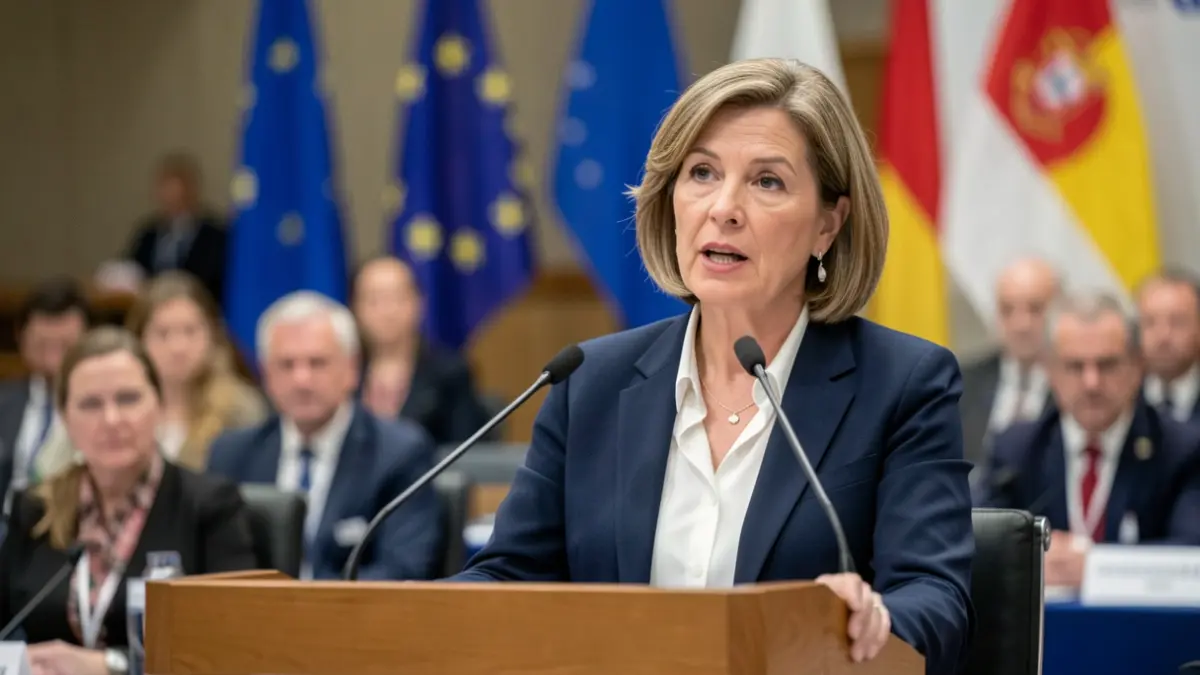
The Minister of Health, Ana Paula Martins, argued in Dublin that public policies to promote healthier eating must empower people to make the right choices and that member states should cooperate in this area. The ministerial conference, hosted by the Irish Presidency of the Council of the European Union, included government representatives from Greece, Sweden, Slovenia, Ukraine, and Lithuania, and took place on November 16 and 17.
“Informing people is not enough. Prevention works when we make the healthy choice the easy choice,” stated the Minister during a panel discussion. Ana Paula Martins explained that Portugal's approach to changing dietary habits has combined public information, fiscal measures, food reformulation, and regulation.
Among the measures already adopted in Portugal are the tax on sugary drinks (introduced in 2017), which includes tax brackets based on sugar content. Consequently, the proportion of drinks in the highest sugar content category decreased by 45% between 2017 and 2025. There has also been a reduction in salt and sugar consumption in certain food categories, achieved through an agreement between the food industry and the state, which led to an average decrease of about 15% in salt and 21% in sugar between 2018 and 2023.
To enhance consumer information, a Digital Food Catalogue was created, detailing the nutritional composition and ingredients of over 2,000 products available on the market, and simplified nutritional information, such as Nutri-Score, was promoted. Special attention was given to child protection, with legislation restricting advertising of foods and beverages high in energy, salt, sugar, or fat directed at children under 16 years, and new rules were introduced for school meals. Portugal also aims to increase the use of digital tools to reduce children's exposure to irregular online advertisements and commercial content.
The panel also featured Maria João Gregório from JA PreventNCD. Portugal's pioneering role in combining public information, food reformulation, and regulation was acknowledged. Portugal coordinates the World Health Organization's European Action Network for the reduction of marketing pressure on children and co-leads the Regulation and Taxation work package of JA PreventNCD.
Ana Paula Martins welcomed the European Safe Hearts Plan and the initiative to develop a common European approach to assess food processing levels. The minister advocated for European cooperation in developing reliable, science-based information tools for consumers and in supporting Member States to implement and evaluate effective food reformulation and prevention policies. She also called for strengthened cooperation to protect children from unhealthy food marketing, particularly on digital platforms.
“"Healthier choices cannot depend on income, education, or where people live"
On the second day of the conference, which also marked a handover as Lithuania assumes the Presidency of the Council of the EU on January 1, 2027, the Minister argued that cardiovascular health should be monitored throughout life. Prevention must go hand-in-hand with early detection, timely treatment, and ongoing care. Investment priorities highlighted included early detection of cardiovascular risk factors and strengthening primary and community care.
Portugal is developing integrated pathways for heart failure and stroke, the cardiovascular component of the Detect SNS 24 program – focusing on the need for citizens to know their own numbers (blood pressure, cholesterol, and blood glucose) linked to primary healthcare, and telemonitoring. These solutions are still under development and validation, and Portugal is available to test them with other Member States.
“"Europe should not have twenty-seven isolated pilot projects"
The Portuguese delegation included Maria de Fátima Franco, director of the National Program for Cerebro-Cardiovascular Diseases (PNDCCV) of the Directorate-General of Health (DGS), and two researchers from INSA – National Institute of Health Dr. Ricardo Jorge, Mafalda Bourbon and Alexandra Bento, working in the areas of cerebro-cardiovascular diseases and food and nutrition.