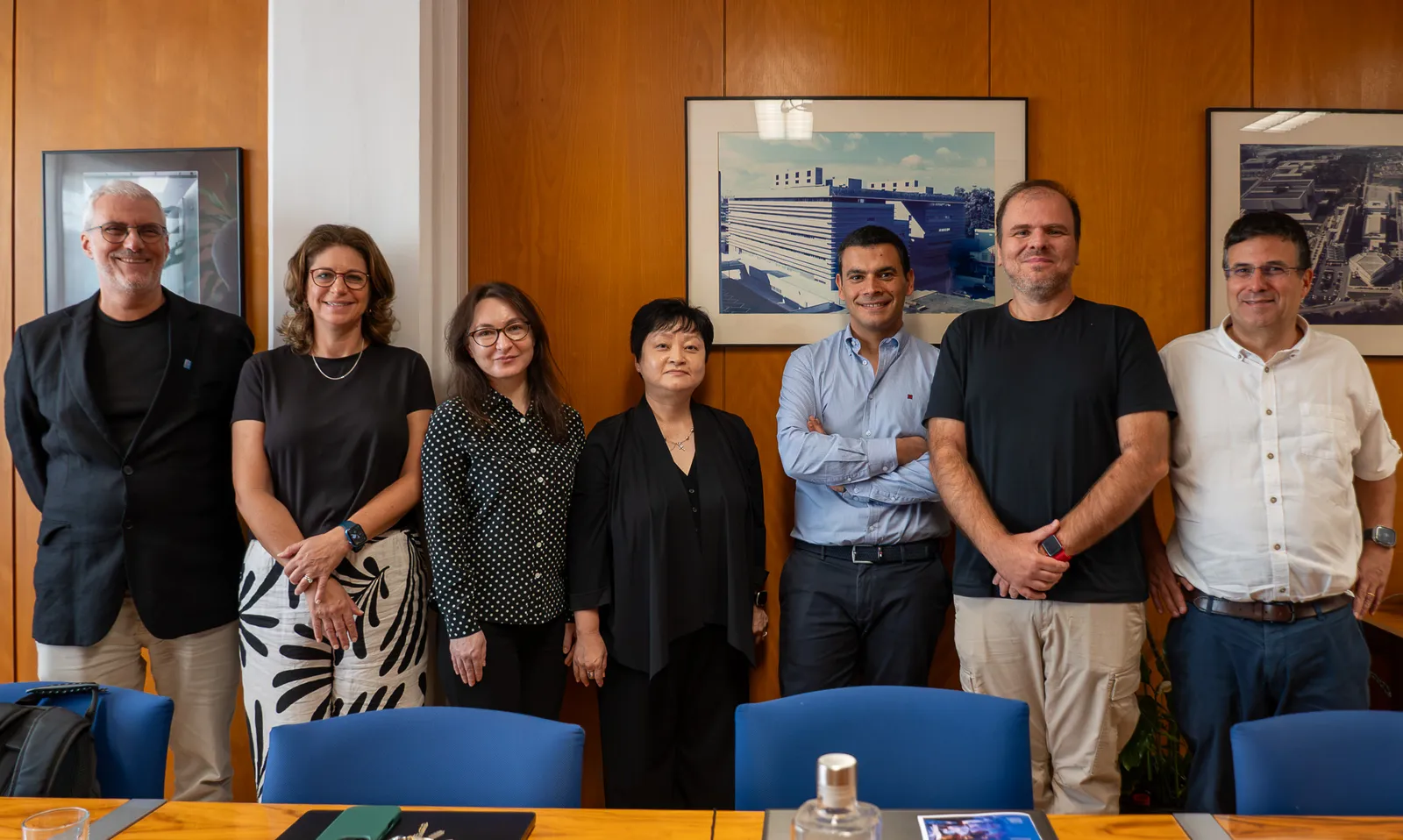
The visit's main objective was to present the Faculty and explore collaboration opportunities between the institutions. The North American delegation included Alicia Goldstein Raun (MIT), Anna Cushing (University of Utah), and Shinsaeng Ko (Emory University). Representing Ciências ULisboa were the sub-director, Professor Jorge Marques da Silva, the President of the Scientific Council, Nuno Araújo, the President of the Computer Science Department, Alysson Bessani, and Filipe Rosas from the Department of Earth and Energy Sciences.
Professor Jorge Marques da Silva opened the session with an institutional presentation, detailing the Faculty's organization, educational offerings, and scientific activities. He emphasized the importance of internationalization in bringing institutions closer and creating new possibilities for scientific collaboration.
“"Internationalization is an opportunity to bring institutions closer and create new possibilities for scientific collaboration."
The representatives from the US universities shared their interests and objectives, initiating a discussion on potential points of contact. This was followed by a panel discussion with professors Nuno Araújo, Filipe Rosas, and Alysson Bessani, where topics such as academic training, international mobility, and opportunities for closer ties between faculty, students, and researchers were discussed.
The Faculty's scientific diversity, spanning areas like Biology, Geology, Physics, Mathematics, Statistics, and Computer Science, was highlighted as a starting point for connecting teaching and research. Shinsaeng Ko from Emory University stressed the importance of identifying common areas of interest and concrete forms of collaboration.
“"It is important to identify areas of common interest and find ways to work together."
The meeting also allowed for an exchange of perspectives on the challenges of internationalizing higher education. Anna Cushing from the University of Utah noted that "Portugal is gaining visibility as a destination for international academic and scientific experiences." The visit reinforced international dialogue and created conditions for identifying future collaboration possibilities.
The program concluded with a group photo and a campus tour, including a visit to one of the Faculty's laboratories, allowing the representatives to experience the teaching and research environment firsthand.