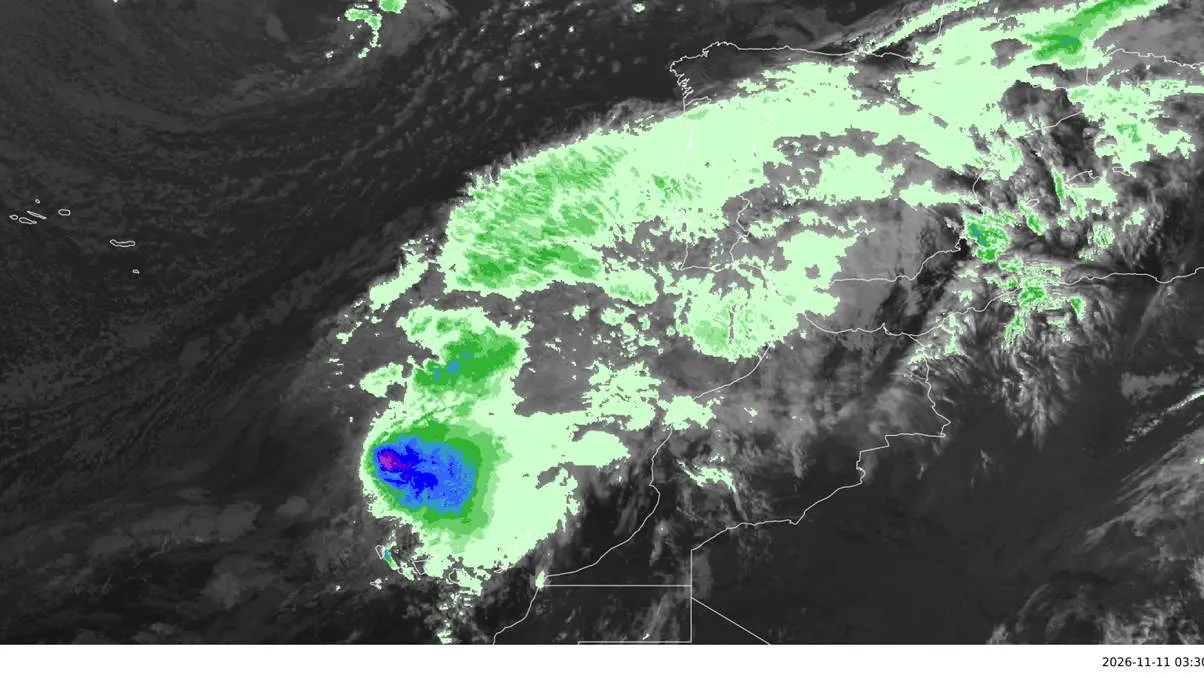
The CLIMA.AML network, composed of automatic weather stations, monitored the effects of the depressions, which brought precipitation and strong winds to the region. Between 07:00 on November 8th and 20:00 on November 11th, stations in Lisbon, Sintra, and Amadora recorded accumulated precipitation values of approximately 178.4 mm, 176.0 mm, and 175.2 mm, respectively.
November 11th accounted for more than half of the accumulated precipitation values (51.7%). The sensors that recorded the highest values in Greater Lisbon were in Sintra (103.4 mm), Amadora (100.2 mm), and Vila Franca de Xira (93.0 mm). In the Setúbal Peninsula, the notable locations were Setúbal (92.2 mm), Almada (81.4 mm), and Palmela (74.0 mm).
The accumulated precipitation recorded in Lisbon, at the Carnide weather station, corresponds to 16.75% of the annual average for 2025 in mainland Portugal (1064.8 mm), according to the IPMA's Annual Climate Bulletin.
The most intense precipitation episodes occurred on November 11th, with highlights in Setúbal (18.2 mm at 03:00), Sintra (15.4 mm at 03:30), and Amadora (15.6 mm at 13:00). The previous day, November 10th, high precipitation intensity values were recorded in the early morning hours on the south bank of the Tagus, in the municipalities of Seixal (16.6 mm), Moita (15.00 mm), and Almada (14.8 mm).
Depressions Bruna and Charles also brought strong winds. In Montijo, a maximum gust of 72.41 Km/h was recorded on the morning of November 10th. In Amadora, two maximum gusts of 67.58 Km/h occurred: on the night of November 8th and in the early afternoon of November 11th. In Setúbal, a maximum gust of 67.58 Km/h was recorded in the early afternoon of November 10th.
Depression Bruna, named by IPMA, formed in the North Atlantic and its effects were felt in mainland Portugal from November 8th onwards, with persistent, sometimes intense, precipitation, thunderstorms, strong winds, and significant sea agitation. Atmospheric instability is expected to continue until at least November 13th.