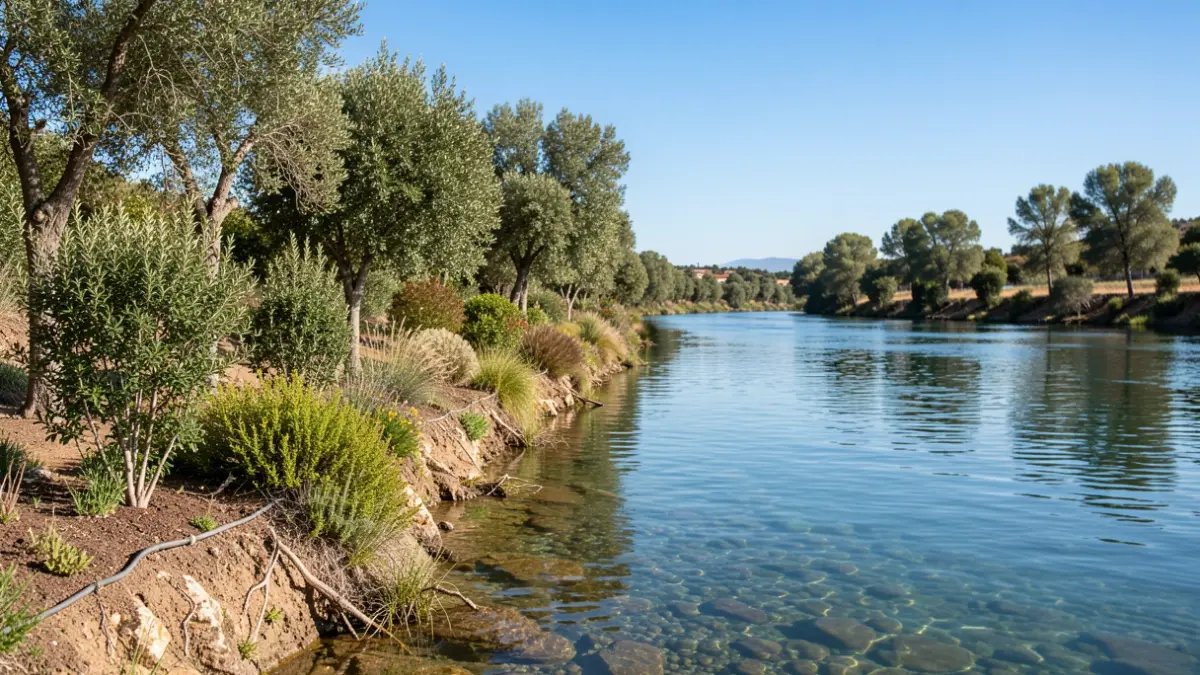
The challenge of promoting the renaturalization and environmental valorization of watercourses, as required by the Water Framework Directive and the Water Law, is being addressed by the Municipality of Pombal through the Strategic Plan for Watercourse Rehabilitation (PERLA). This plan characterizes the current state of the municipality's watercourses and proposes actions for their rehabilitation.
Between 2022 and 2024, the Arunca River underwent a natural regeneration process. In a second phase, between 2024 and 2025, a project was implemented for the stabilization, renaturalization, and integrated improvement of the banks and bed of the Arunca River and the final stretch of the Cabrunca River, covering approximately 30.5 km. This intervention, funded by the Environmental Fund with 520,000 euros and spanning 97 hectares, included the planting of 15,690 native trees and shrubs, such as willow, alder, ash, and oak. The process resulted in increased biodiversity and improved water quality, with native plants contributing to pollutant filtration and maintaining lower temperatures.
Species like Tábua-larga and Lírio-amarelo-dos-Pântanos, found in the bed of the Arunca River, are known for absorbing heavy metals and pollutants. The appearance of fauna sensitive to environmental quality, such as otters, kingfishers, and ringed plovers, indicates improved water quality and biodiversity. In 2026, an annual active management plan is underway, involving clean-ups, invasive vegetation control, and monitoring.
Currently, works are being carried out to clear blockages and regularize the riverbed and banks in the Arunca River Urban Corridor, within the urban area of the city, in response to the early-year weather events. The objective is to improve surface water flow, reduce flood risks, and safeguard people and property. The works include waste removal, selective vegetation cutting, and management of riparian vegetation and bank sediments.
Achieved results include improved water quality and conditions supporting biodiversity. Long-term expectations are the recovery of the riparian gallery, bank stabilization, restoration of fluvial connectivity, ensuring watercourse flow, and flood prevention.
Renaturalization aims to foster biodiversity, improve water quality, and prevent flood risks. The creation of green corridors returns the river to the community for enjoyment. The Municipality has opted against installing sluice gates, aligning with the renaturalization strategy and climate change adaptation, thereby avoiding water stagnation and eutrophication.