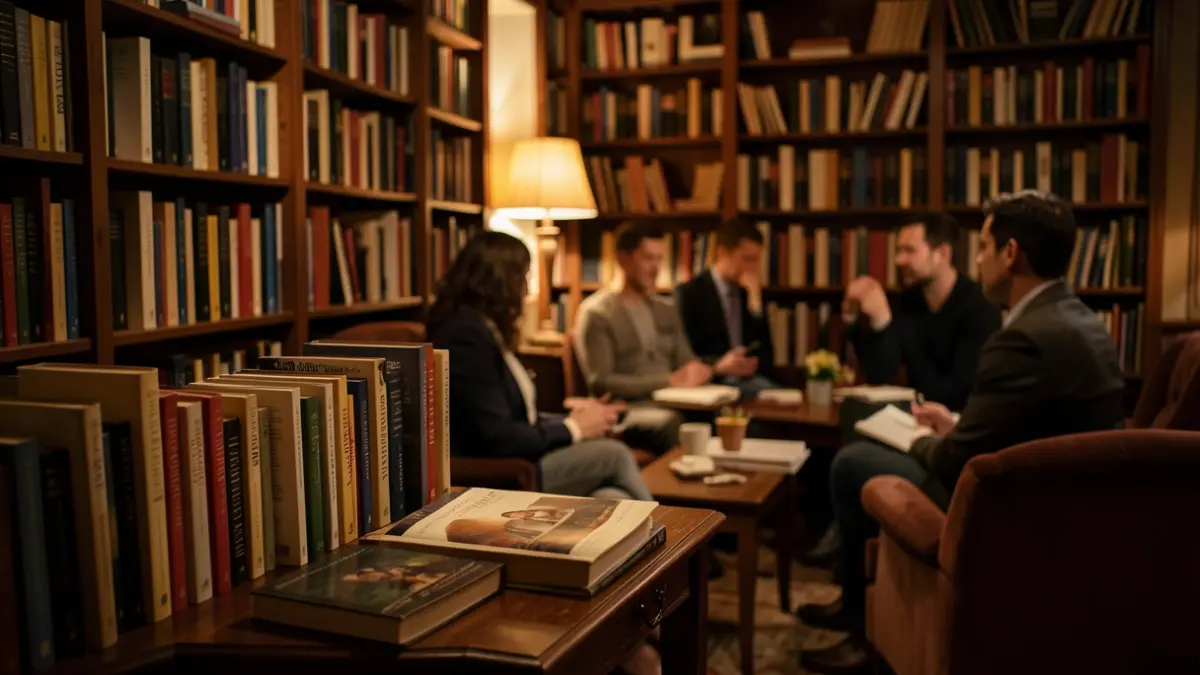
During a debate on "AI and literary creation – Authorship, voice, originality," Patrícia Akester explained that AI-generated outputs can replicate original works, raising legal questions. "We are in front of the laptop and outputs appear that, when they emerge, replicate almost entirely original works used to feed the machine," she stated. The jurist mentioned court cases in the United States, such as the one initiated by The New York Times against an AI company due to content replicas.
Akester clarified that copyright law covers not only texts but also images and voices, citing a 2011 Vatican law that protected the Pope's intellectual productions. However, the main issue lies in using this content as "food for the machine." The jurist identified a "crossroads" where the law, which presumes a connection between human author and work, contrasts with AI's practice of generating rather than creating.
“"A country needs culture. It's the root that enters the earth, into our soul, into our heart, and stays. If we don't care for copyright, we have no culture."
Rosely Boschini, CEO of Editora Gente, considered that the era of piracy might have been less harmful than the current impact of AI, which "mixes" texts in a way that the original author is not recognized. "We are going through a phase that will have to be resolved," she advised, emphasizing the importance of culture and copyright for a country's identity.
Boschini advocated for responsible AI use in writing, not as a shortcut, but as a support tool. "An author sometimes spends a lifetime writing a work because they want to give the public the best. And they should be valued and well-remunerated for it," she stressed, adding that AI does not replace the "repertoire" and the "unique perspective" of a human author.
Cibele Costa, a verbal branding specialist, drew a line between AI-produced texts and those written by authors, arguing that machines lack "affection" and the ability to construct a genuine story. "It seems like it, but it's not human language. The construction is original, and should not be copied," she argued. Costa mentioned the cancellation of a literary award in Curitiba and the lawsuit filed by writer Fernando Morais against Open AI as examples of the difficulty in dealing with AI-generated works.
Carlos Galveias, an AI specialist, pointed to laziness as a disadvantage of excessive tool use, advocating for its use as "research assistance" and warning against life being "controlled by a machine." Galveias recalled that AI consumes vast amounts of data, including books and emails, and cautioned that human intellectual production might soon be exhausted as a source for AI, with the journal Nature predicting this could happen by 2030.
Patrícia Akester recalled 19th-century piracy and the creation of international conventions to combat it. Currently, the situation is exacerbated by the refusal of some American companies to comply with copyright protection parameters, despite the European Union's willingness to legislate. The jurist cited a statement by Donald Trump in July 2025, questioning the need to pay for books when China does not, and lamented that, in this geopolitical context, "it is very difficult to defend copyright. We diminish the cultural landscape and become poorer."