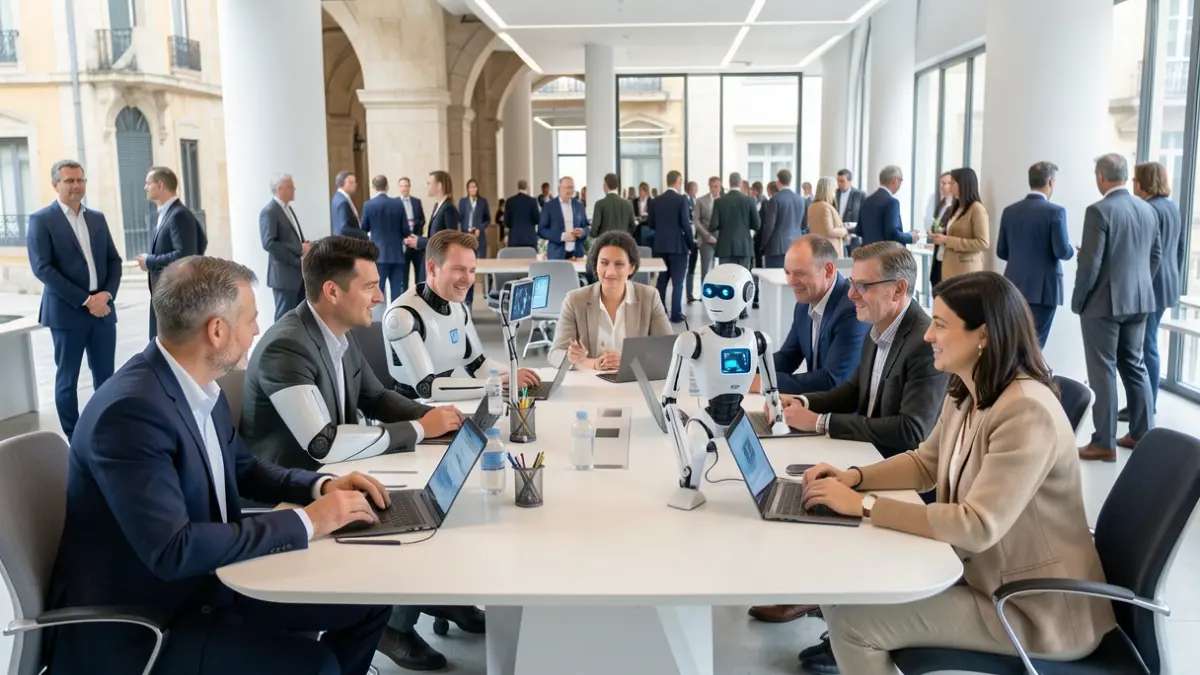
Artificial intelligence is accelerating business transformation, but technology is only part of the problem. How to prepare workers for roles that do not yet exist? How to lead teams with different expectations, in a context where humans, artificial intelligence agents, and robots may work side by side? These were some of the questions that marked the Executive Breakfast promoted by FEP, on October 23rd, under the theme “Future of Work 2030: How Organizations are preparing for the major transformations in the next decade?”. The meeting brought together business leaders from different sectors to discuss the changes that are redefining the world of work, in a debate that highlighted a central challenge: the ability to incorporate new technologies must be accompanied by a transformation of leadership models, learning, and people management.
The initiative is part of a series of executive breakfasts on the Future of Work, FEP's theme for the 2026/2027 academic year, dedicated to the challenges and opportunities transforming work, skills, and organizations. The speed of technological transformation is forcing companies to review processes, roles, and skills. At Corticeira Amorim, with 156 years of history, adaptation is not new, but the acceleration of change poses new demands. Alexandra Godinho, Head of Corporate Human Resources, recalled that the company has doubled its revenue in the last 15 years and has followed a technological evolution marked by automation and, more recently, artificial intelligence. The challenge is to prepare people for a reality where some traditional professions disappear and others require different skills, through reskilling and skills development processes, as well as the creation of dedicated training structures.
At Sogrape, digital transformation is strategic. André Campos, a member of the Board of Directors and Chief of People and Transformation Officer, highlighted the speed at which artificial intelligence is being adopted, “above initial expectations”. With operations in eight countries and over a thousand employees, the company faces the challenge of keeping pace with this evolution in a structure that integrates very different professional realities. For the executive, “leadership will have to evolve to a context where managing people will no longer be enough”: it will also be necessary to “coordinate the interaction between workers, artificial intelligence agents, and robots. This change places empathy and the ability to understand people at the center of the transformation”. The question is no longer just about knowing what tools will be available, but understanding how to integrate them into work and ensure that professionals have the conditions to keep up with the change.
The transformation of leadership is an area where resistance to change is felt most intensely, according to Alexandra Godinho. Models based on constant availability to companies and an almost exclusive focus on results may no longer meet the expectations of younger generations. Organizations also need to prepare workers for professional contexts that require resilience, autonomy, and tolerance for ambiguity. Ana Queiroga, HR Director of Grupo MDS, emphasized the “importance of leaders capable of supporting fieldwork, guiding employees, and supporting their development”, also drawing attention to the “need to align formal career models with the real experience of professionals”.
At Deloitte, artificial intelligence is being integrated to enhance productivity and dedicate more time to human skills, such as critical thinking and relational skills. Margarida Uva, Associate Partner, highlighted the importance of “empowering leadership itself to use digital tools”. If technology allows tasks to be performed more quickly, the freed-up time will depend on the organizations' ability to invest in developing their professionals and redesigning work. Technological training should be complemented by the development of human skills, where the ability to learn, question, and adapt may be as important as mastering a specific technology.
The discussion extended to the need to develop critical thinking in a context where artificial intelligence makes it easy to obtain answers. Filipa Pires, executive director of Pessoas e Sistemas, brought to the discussion the contribution of philosophical coaching and formulating questions as “instruments to stimulate thinking”. The “ability to question, analyze problems, and explore different perspectives” gains relevance in a reality where task execution may be progressively automated. Organizations will need to find ways to develop these skills and prepare people for roles that require greater autonomy, creativity, and decision-making ability.
The debate featured participation from Alexandra Godinho (Corticeira Amorim), Ana Queiroga (Grupo MDS), André Campos (Sogrape), and Margarida Uva (Deloitte). Representatives from other organizations were also present, including Jorge Rodrigues (Amkor Technology Portugal), André Braga (Crédito Agrícola), Sandra e Sousa Amorim (EY), Alberto Pinto (FairJourney Bio), Pedro Martins (MDS), and Cília Assis (uMan Xpert). FEP was represented by its Director, Óscar Afonso, among others.