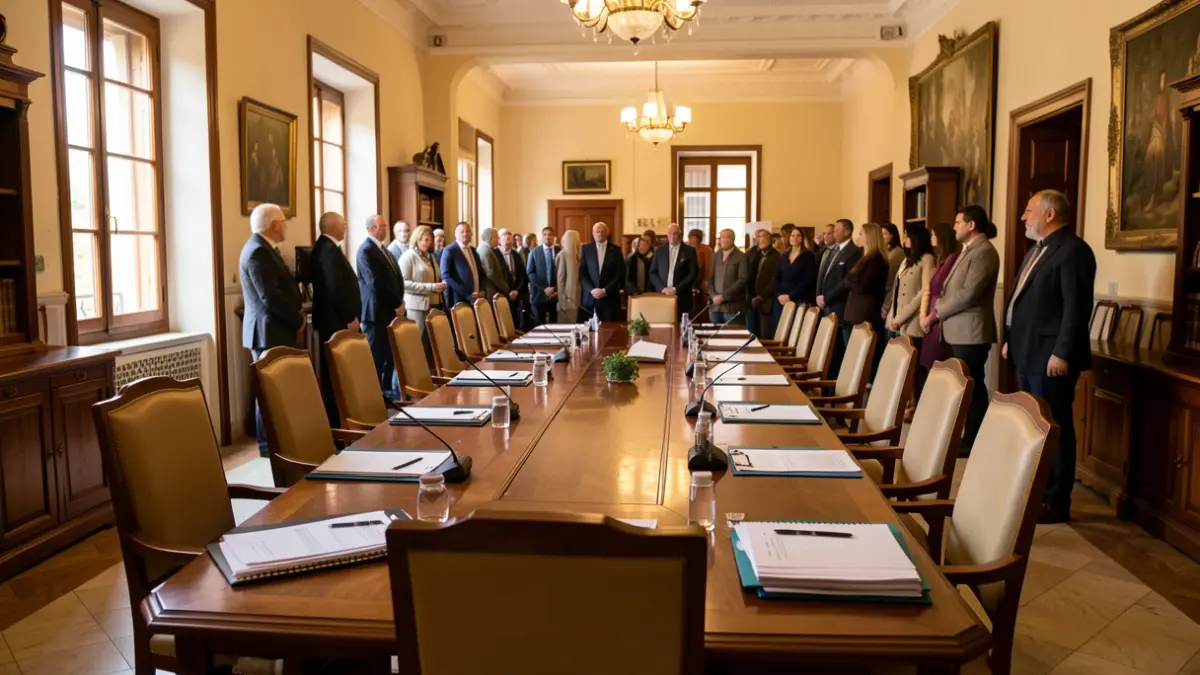
LIPOR hosted, on November 5th and 6th, the mission of the circular economy group from the EU Cities Gateway project (2025-2029), a program funded by the European Union that builds bridges between cities and regions in Europe, the United States, and Canada. The visit, which also included a stop at Porto Ambiente, concluded with an extremely positive assessment and opened a vast horizon of opportunities for future project development.
The delegation included representatives from seven participating cities: Albacete (Spain), Debrecen (Hungary), Boulder (USA), Phoenix (USA), Riga (Latvia), Terrebonne (Canada), and Guelph (Canada), who had the opportunity to closely examine the Portuguese model of waste management and valorization, internationally recognized for its integrated and innovative approach.
The EU Cities Gateway is an initiative connecting cities and regions from the European Union, the United States, and Canada, promoting the exchange of best practices and the creation of joint solutions for the challenges of climate transition and the circular economy. The choice of LIPOR and Porto Ambiente as the destination for this mission is a clear recognition of the quality of work developed in Portugal and places the country at the center of an international cooperation network with high potential impact.
The first day, November 5th, was dedicated to LIPOR, with presentations on the Waste Management and Valorization System, Environmental Awareness Strategy, food waste projects, prevention, circular economy, and selective collection. The delegation visited the Automatic Packaging Sorting (TAE), the WEEE Collection and Repair Point (Crew), the Organic Valorization Plant, and NUTRIMAIS production.
The second day focused on the visit to Porto Ambiente, with the presentation of the Roadmap for the Circular Economy 2017-2030 and a visit to the EcoPorto Project. The coordination between the municipal strategy and on-the-ground projects was highlighted as an inspiring example of local governance oriented towards sustainability.
The final assessment of the mission was extremely positive, with the international group expressing satisfaction with the activity developed and the quality of work by the involved teams. This mission served as a starting point for new international collaborations, with the potential to generate joint projects and establish Portugal as a reference in the transition to a circular economy.