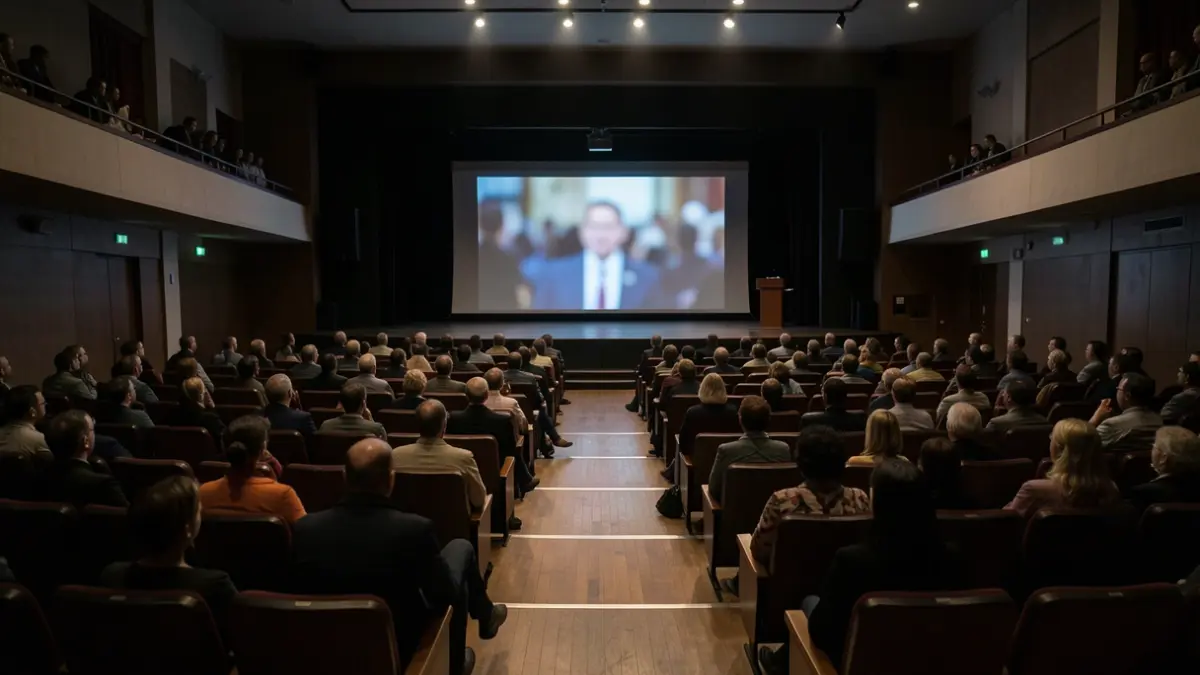
On the island of Graciosa, the story of Luís Rocha Monteiro, a researcher who gave his name to a small seabird, was celebrated this Saturday afternoon, November 21st. The screening of the documentary “O Voo de Monteiro”, by Paulo Ferreira, attracted a numerous audience to the Municipal Auditorium of Baião, including family, friends, and colleagues from the Azores and the mainland. After the film, testimonies from those who knew Luís and his work highlighted the importance of the son of Santa Leocádia for understanding the archipelago's seabirds.
The President of the Municipal Chamber of Baião, Ana Raquel Azevedo, sent a video message, while the Councilor for Culture and Environment, Olívia Mendes, thanked everyone for attending and recalled previous tributes, explaining that the current executive aimed to give a new dimension to this recognition.
During the panel discussion moderated by Rui Leal, a friend of Luís, director Paulo Ferreira shared that the idea for the film arose while he was working in the Azores on biodiversity promotion. Upon learning that a seabird was named after a man from Baião, he felt compelled to investigate Luís Rocha Monteiro's journey, finding common ground with the Azorean nature, much like himself, a native of Gondomar, who also came from the north of the country.
Carlos Picanço, a technician from the Environment and Climate Action Service of Graciosa and an island native, immediately supported the documentary proposal, expressing his satisfaction at seeing the story of the researcher linked to a rare Azorean bird told. He later collaborated on reviewing the film's content.
Paulo Rocha Monteiro, the honoree's brother, recalled field campaigns shared with Luís on the islets, where they would locate colonies and count birds by their songs, using recorded tapes as a reference. A trip to Ilhéu da Praia particularly marked him, as rough seas prevented their timely return, leaving them stranded for the day with little food and water. Despite this, Luís still wanted to proceed to another listening point. Paulo became emotional recounting the joy of accompanying his brother and recognized Luís's discretion in Paulo Ferreira's portrayal.
Paulo emphasized that the discovery of the Monteiro's storm petrel is just one part of Luís's legacy, a pioneer with firm ethical convictions and intellectual ambition, who felt the need to go into the field to observe birds up close and seek answers that office work alone could not provide.
Born in Santa Leocádia in 1962, Luís Rocha Monteiro graduated in Environmental Engineering from the University of Aveiro and spent much of his career at the Department of Oceanography and Fisheries of the University of the Azores. He earned his doctorate from the University of Glasgow with research on what seabirds could reveal about mercury contamination in the ocean. He observed that birds with nearly identical appearances had different mercury concentrations and reproduced in the same locations at different times.
In 1998, he co-authored a study with Robert Furness hypothesizing different species. Luís died the following year, at 37, in a plane crash in the Azores. In 2008, an international team formally described the species that reproduced during the warmer season, naming it the Monteiro's storm petrel. Luís's interest in nature conservation also extended to his native municipality, having written in 1988 about the vegetation of Carvalhal de Reixela and its importance.
Paulo Travassos, vice-president of the Portuguese Society for the Study of Birds, highlighted Luís's insight in linking mercury study with bird identification and his ability to anticipate issues, bringing together researchers from different fields. Many Portuguese ornithologists, he added, were already familiar with Luís's work before hearing about the storm petrel. Travassos himself, though he never studied the species, first heard of it through the researcher from Baião. The nocturnal listening sessions described by the brother served as a reference for a later seabird census and mapping project, following a protocol "designed according to what had been used in the 90s." The European Union and other entities have since funded numerous projects dedicated to the study and monitoring of this and other seabirds.
Ana Veloso, Luís's wife, shared personal memories, emphasizing their connection through music and her husband's thoughtful gestures, such as the tapes he recorded for her. She described him as an organized, dedicated, and attentive man. His Environmental Engineering background helped him connect laboratory learning with field observations. After his death, the scope of his work became more evident when colleagues had to share his responsibilities.
His daughter, Eva Monteiro, emotionally thanked the Municipal Chamber of Baião for the tribute, expressing her happiness that her father's work, which holds special meaning for the family, is being recognized in his hometown.
The documentary “O Voo de Monteiro” was supported by the Municipality of Baião, the Municipality of Santa Cruz da Graciosa, and the Regional Secretariat for Environment and Climate Action of the Azores.