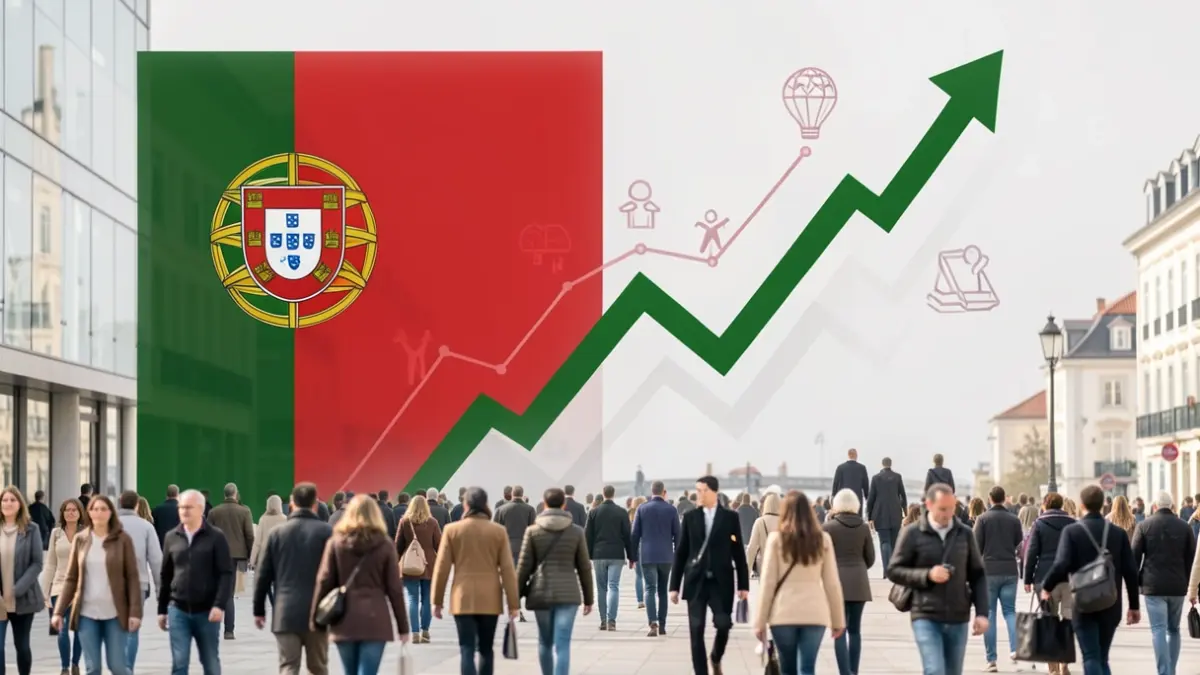
With this score, the country ranks 9th among the 27 Member States, placing it 1.2 points above the EU average (64.5). The recent progress is mainly due to the domains of power and health, with Portugal recording the fourth largest increase in the EU over the past year.
The power domain gained 6.6 points, reaching 43.4 points (11th position in the EU), and remains the domain with the country's lowest score. The biggest leap occurred in social power (+9.7 points), with women now occupying 26% of decision-making positions in national Olympic sports organizations. In political power, women represent 40% of ministerial positions and 36% of parliamentary seats. In the largest listed companies, they hold 36% of board positions.
In work, Portugal stands out with 75.7 points (8th position in the EU). The full-time equivalent employment rate is 51% for women and 61% for men, both above the European average. However, the disparity is 11 percentage points in couples with children, compared to 2 percentage points in couples without children.
In the health domain, with 82.1 points, Portugal ranks 23rd. The health status subdomain is last in the EU, despite a 3.0-point increase. Only 49% of women and 56% of men rate their health as 'good' or 'very good'. Portugal also has the largest gender disparity in the EU for healthy life years at age 65.
The money domain decreased by 0.4 points, with the economic situation of women employed in single-adult or single-parent households showing a poverty risk of 17%. The gender pension gap is 22%. In the time domain, 66% of women perform daily domestic tasks, compared to 44% of men, the highest values in the EU.
In knowledge, 50% of women aged 30-34 have completed higher education, compared to 34% of men, although segregation persists in STEM fields. Regarding violence against women, 20% of women in Portugal have experienced physical and/or sexual violence since age 15, compared to 31% in the EU average.